Project overview
QueueCore is a speculative product concept — designed to explore what a fully integrated barbershop management platform could look like if built from scratch.
Barbershop owners are stuck juggling a disconnected stack of tools — one app for booking, another for POS, spreadsheets for inventory, and gut instinct for everything else. The result is data silos where owners can see what happened but never why. They can’t tell which barber is driving the most repeat business, which service is trending, or where revenue is leaking.
I designed QueueCore to be more than a scheduling tool — it’s an intelligent shop assistant. By leveraging real-time data across every touchpoint, it transforms reactive management into proactive, data-driven decisions. The platform consolidates six fragmented business needs into a single cohesive experience: Scheduling, Payments, Staff Management, Retail, CRM, and Analytics.
This was a full 0→1 product design effort. I owned every layer — from secondary research and information architecture to design system creation, data visualization strategy, and final high-fidelity screens across all core modules.
Actionable intelligence, not just dashboards
Integrate “Smart Insights” across every page — proactive, plain-English suggestions powered by live shop data, not passive charts that require interpretation.
Unified financial transparency
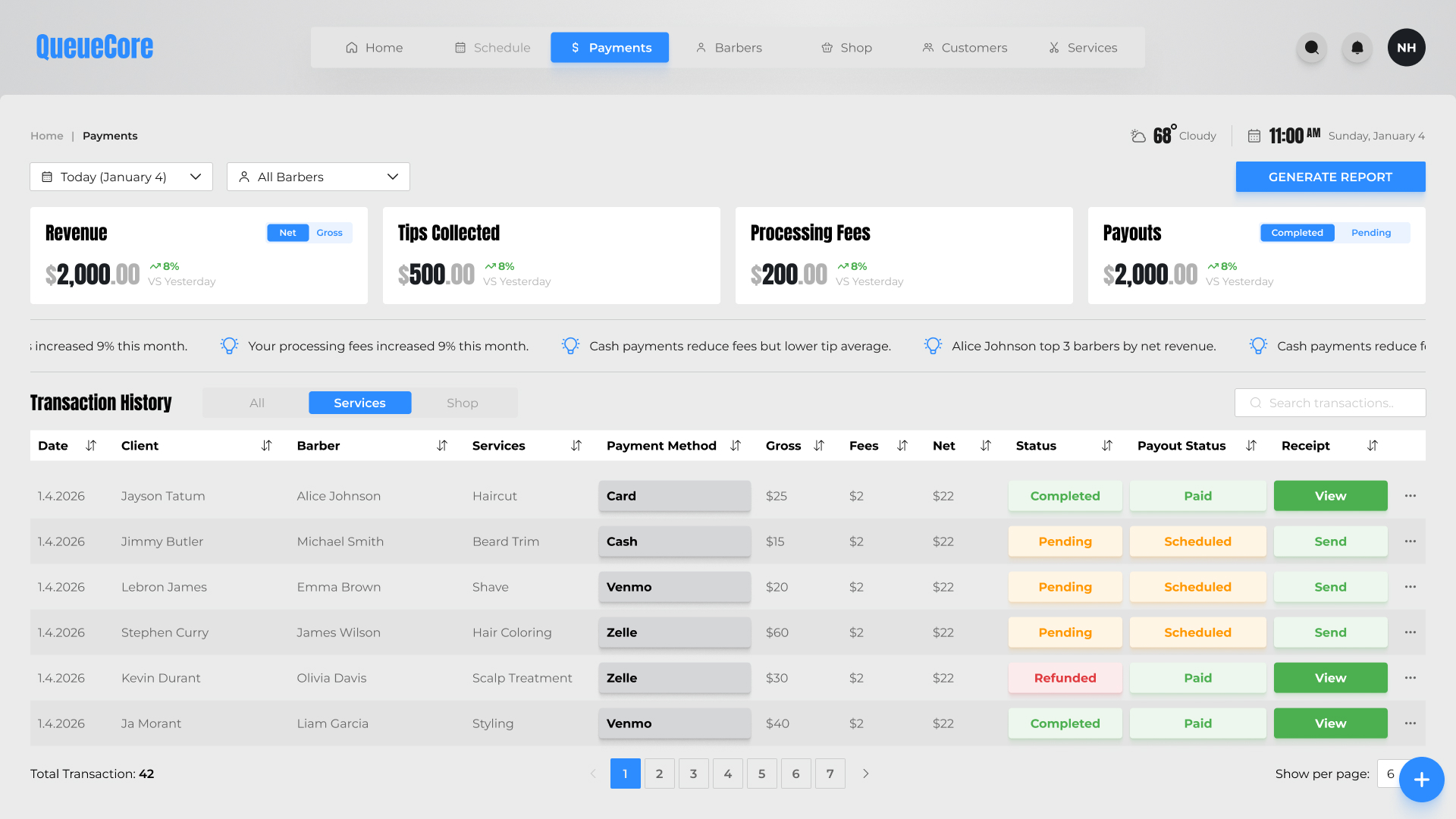
Design a payment ecosystem that handles complex barber splits, tips, processing fees, and payout tracking in real-time — with clear Gross vs. Net breakdowns at every level.
Staff empowerment through data
Build a performance-tracking system that motivates barbers through visible KPIs — rebooking rates, upsell percentages, no-show tracking, and daily revenue contribution.
Bridge retail into services
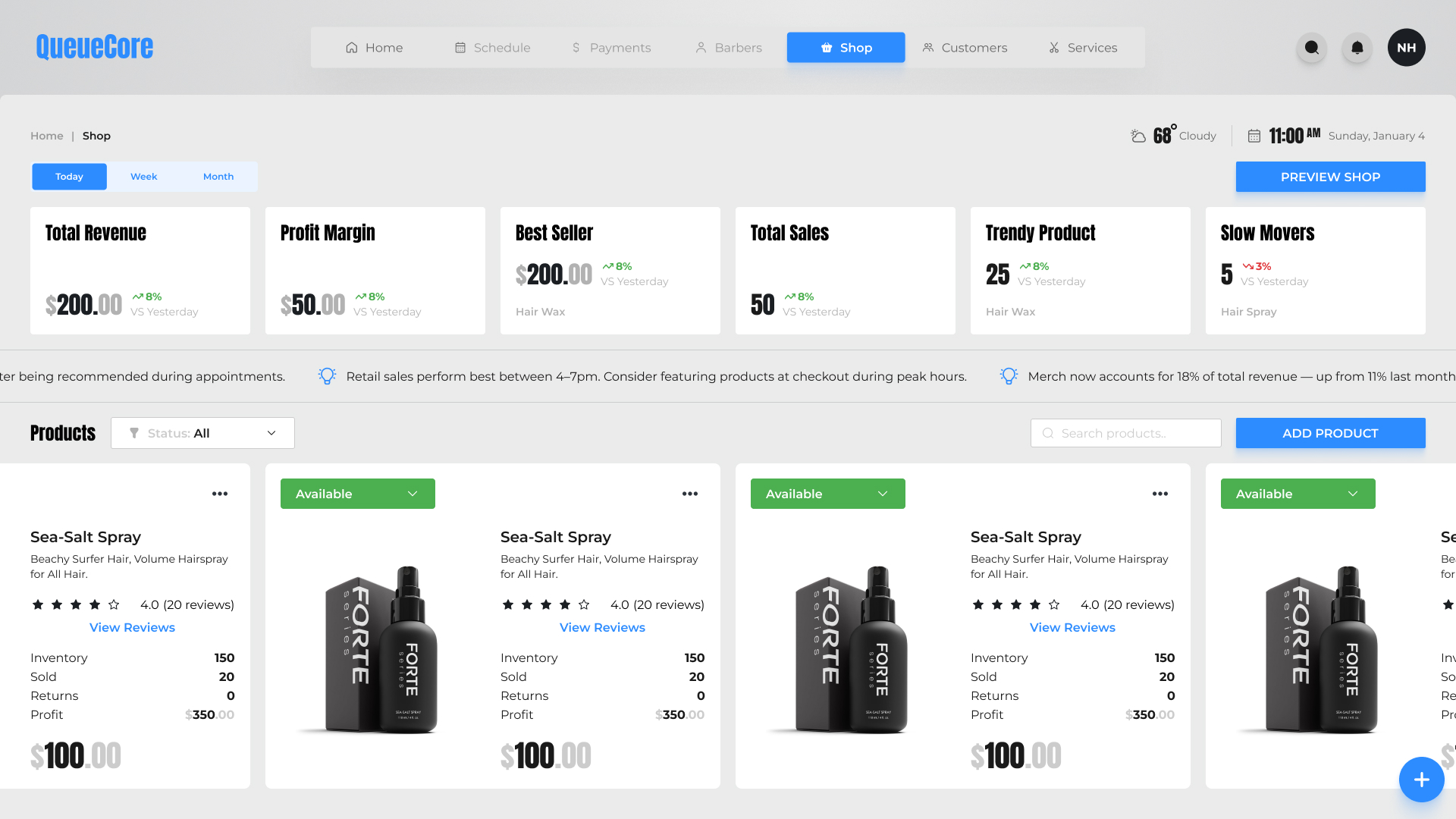
Integrate product inventory with the appointment flow to surface upsell opportunities at the exact moment they’re relevant — maximizing “Average Ticket Value” per visit.
Secondary research & workflow audit
I mapped the daily operations of high-volume barbershops, identifying that walk-ins remain the single biggest friction point — they’re unpredictable, interrupt flow, and aren’t tracked well. This insight led to the “hybrid calendar” concept: a unified view that balances scheduled appointments with a live digital queue. I scoped the MVP around four high-impact areas: revenue transparency, the hybrid calendar, retail integration, and retention logic.
Design system architecture
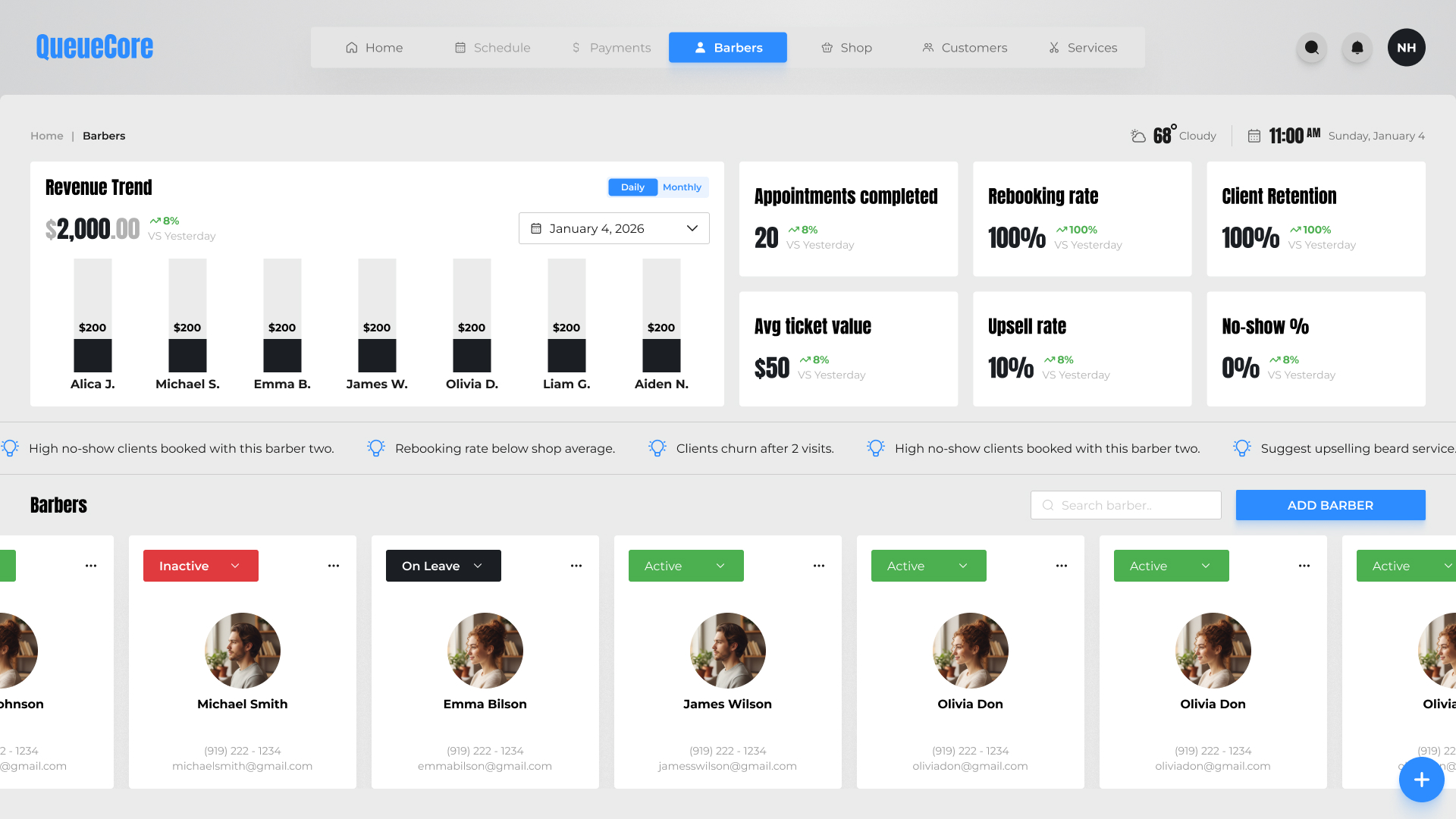
Before designing a single screen, I built a “High-Velocity” design system tailored for a fast-paced, often chaotic environment. I established a status-driven color language — Active/Green, Inactive/Red, On Leave/Black — for instant recognition from across the room. Card-based layouts and modular grids were designed to display dense metrics (Lifetime Value, Revenue Trends, Heatmaps) without overwhelming the user.
Data visualization strategy
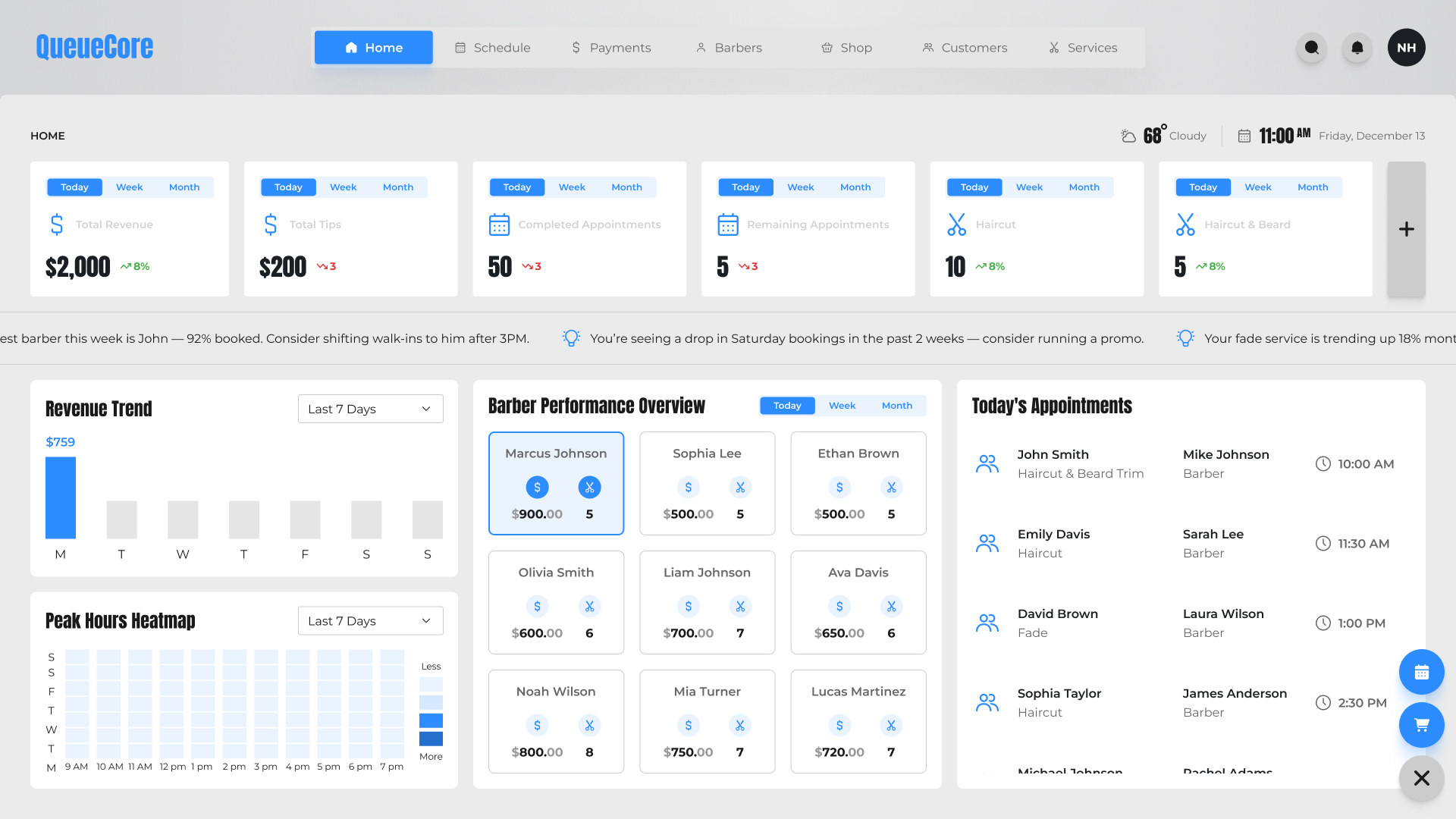
I designed three core visualization systems: a real-time revenue trend line (daily/weekly/monthly), a peak-hours heatmap that reveals booking patterns at a glance, and a barber performance leaderboard that ties individual output to revenue. Each visualization feeds into the “Smart Insights” bar — translating raw numbers into actionable suggestions.
End-to-end screen design
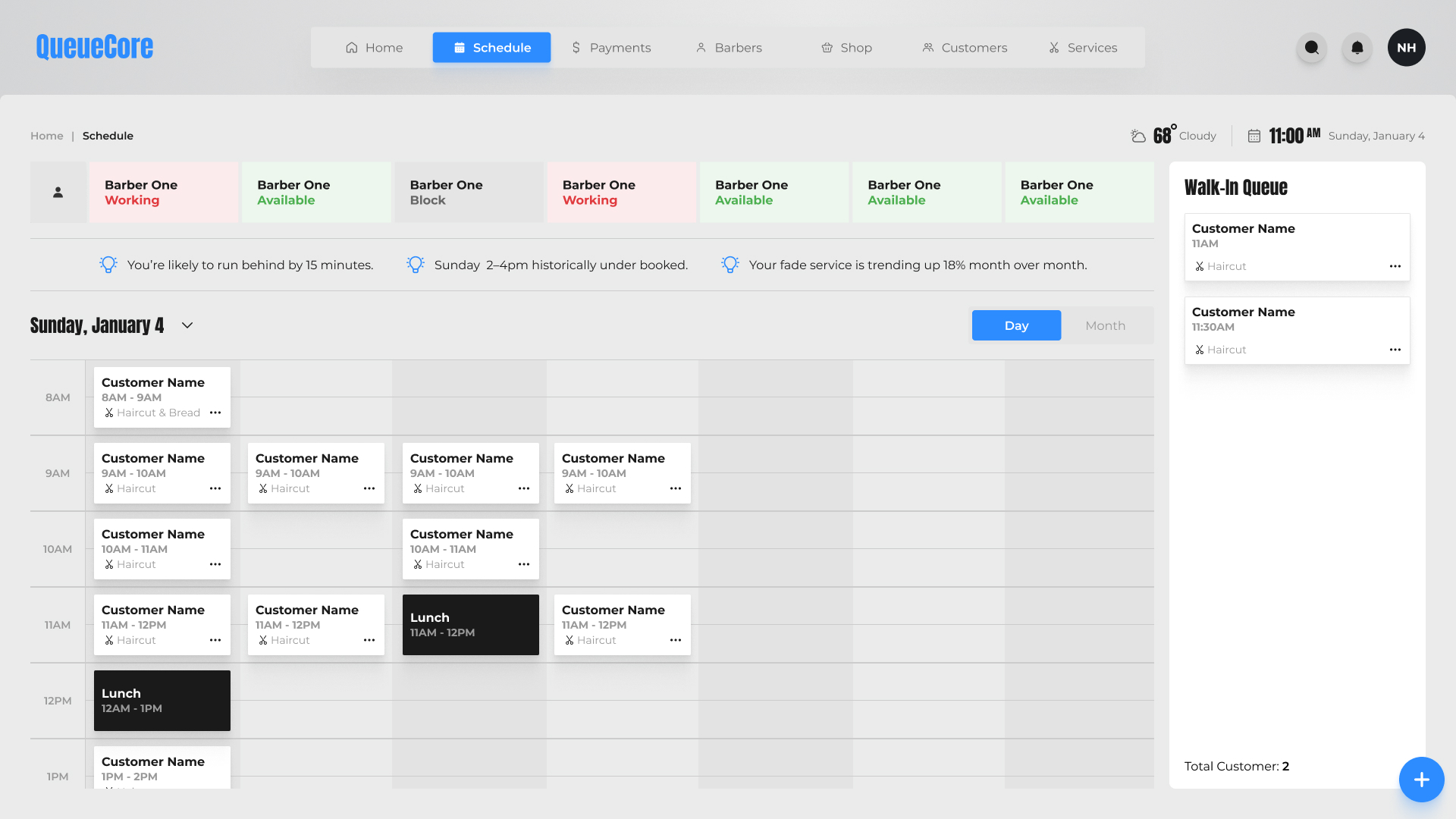
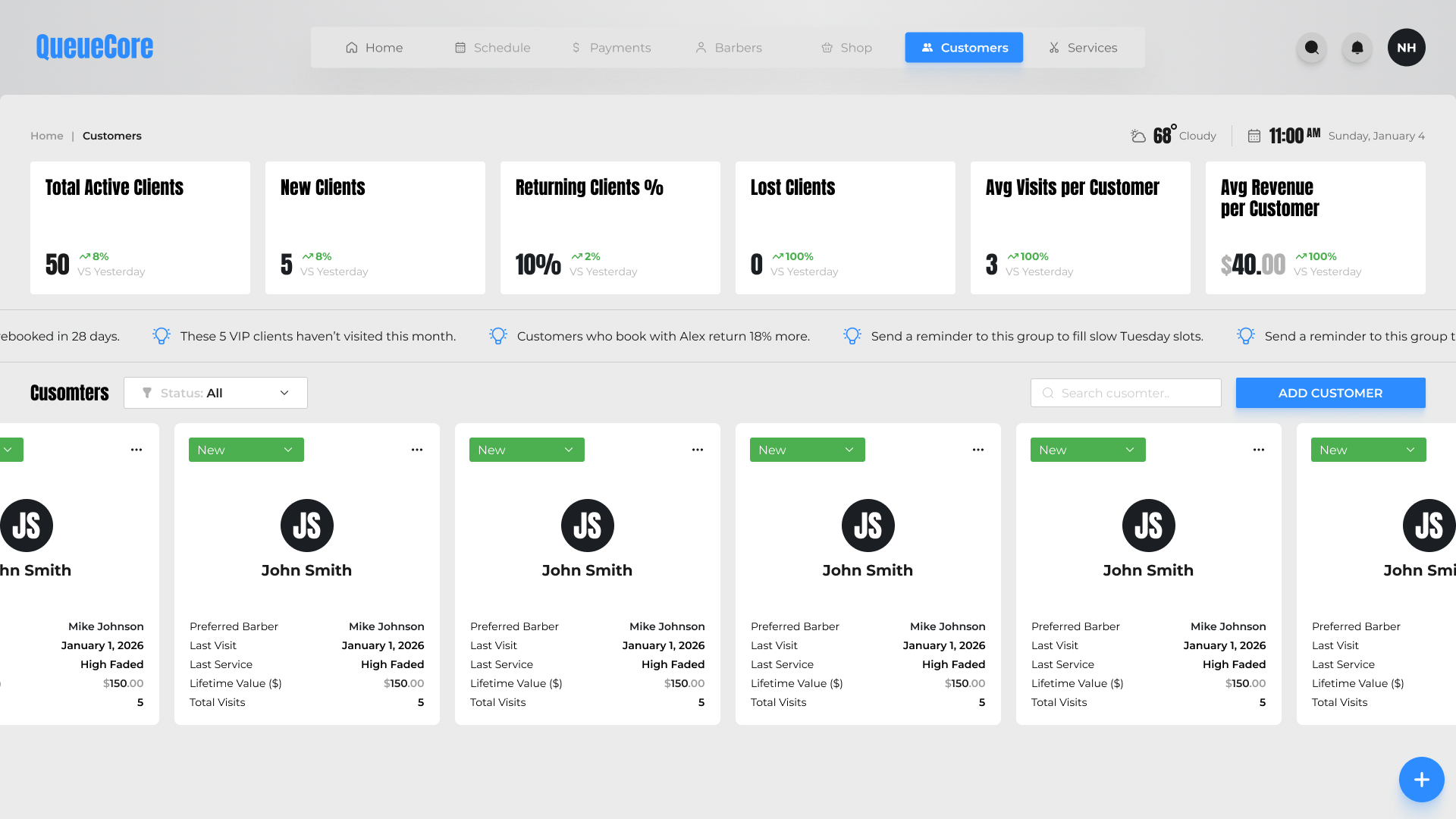
With the system and data strategy locked, I designed all seven core modules: Home Dashboard, Schedule (hybrid calendar + walk-in queue), Payments (transaction history + Gross/Net + payout status), Barbers (performance profiles + KPI cards), Shop (inventory + retail bridge), Customers (CRM + retention flags), and Services (catalog management). Every screen was optimized for high-contrast readability and large touch targets — because barbers use this mid-service, often with wet hands.
Smart Insights engine
A contextual alert bar across every page that translates raw shop data into plain-English suggestions — “You’re likely to run behind by 15 minutes” or “Saturday bookings dropped — consider running a promo.”
Hybrid calendar system
A unified scheduling view that manages both pre-booked appointments and live walk-ins side by side — with drag-to-assign, barber availability status, and real-time queue position tracking.
Barber performance profiles
Individual barber dashboards showing daily revenue, appointments completed, rebooking rate, client retention, average ticket value, upsell rate, and no-show percentage — all with comparison indicators.
Transparent payment hub
Full transaction history with per-barber filtering, Gross vs. Net breakdowns, processing fee tracking, tip collection, payout status (Completed/Pending/Scheduled), and one-click receipt generation.
Peak-hours heatmap
A color-coded weekly heatmap revealing exactly when the shop is busiest — surfacing underbooked windows for targeted promotions and exposing scheduling inefficiencies at a glance.
Retention & churn logic
Automatic identification of “at-risk” and “lost” clients based on visit frequency patterns — flagging customers who haven’t rebooked within their typical cycle and prompting outreach before they churn.
Data is only useful if it’s actionable
Displaying a revenue chart is table stakes. The real design challenge was building a UI layer that explains why the number changed — whether from higher no-shows, successful upselling, or a slow Saturday. Context turns metrics into decisions.
“The software should assist the workflow, not interrupt it.”
Design for “wet hands”
Barbers are moving fast, mid-service, often between clients. Every interaction had to be scannable and one-tap. Large touch targets, high-contrast type, and visual hierarchy that communicates status without requiring reading — the software should assist the workflow, not interrupt it.
Recognition drives motivation
Integrating staff photos, performance badges, and visible KPI rankings transformed what could have been a cold management tool into something that motivates the entire team. When barbers can see their own growth, they invest in the platform — driving adoption from the bottom up.
Density requires discipline
Displaying six modules’ worth of data in a single platform is an information architecture challenge, not a visual one. The card-based modular system let me increase density without sacrificing clarity — users learn the pattern once and navigate everything.